Midway through seven years of abundance?
Just like the Pharaoh’s dream in the Book of Genesis, the market appears to be midway through seven years of abundance. 2025’s 18% return for the S&P 500 index extended the bull market (which started in late 2022) into its 4th year. According to research from JPMorgan, in 2025 the forward P/E of the S&P 500 only rose by approximately 3%; the rest of the market’s 18% YTD gain was attributable to earnings growth. The rally broadened beyond the US to Europe (+35% in USD), Emerging Markets (+33%) and other areas of the market such as precious metals. Gold rose +65% and Silver +147%. Since 1949, there have been eight bull markets which have extended beyond 3 years. According to research by BAML, these eight bull markets lasted 7 years on average with a typical cumulative gain of 234%. The average year four return, based on this data, is +15%. Since 2022, AI related stocks have been responsible for 78% of the stock market growth in the S&P 500 and 66% of earnings growth. While the S&P 500 ex-AI has grown its earnings by 19% since 2022, European stocks have only had about 4% of earnings growth in the same period of time.
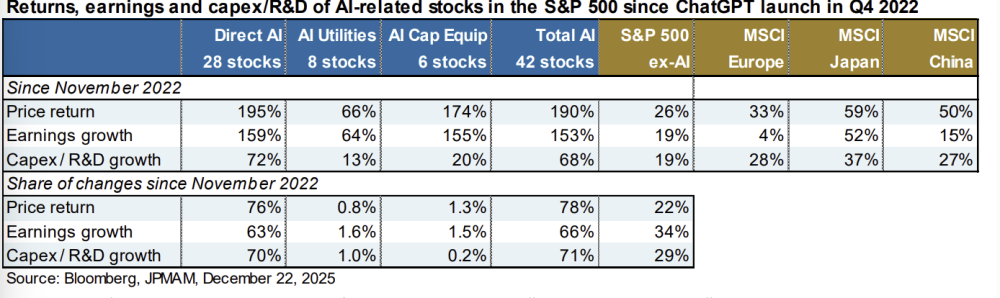
JPMorgan’s S&P 500 AI universe is composed of 42 stocks from three categories. Direct AI (28): NVIDIA, Microsoft, Apple, Alphabet, Amazon, Meta, Broadcom, Tesla, Oracle, Palantir, AMD, Salesforce, IBM, Uber, ServiceNow, Qualcomm, Arista, Adobe, Micron, Palo Alto, Intel, Crowdstrike, Cadence Design, Dell, NXP, Fortinet, HP and Super Micro Computer. AI utilities (8): NRG, Vistra, NextEra, Southern, Constellation, Public Service Enterprise, Entergy, NiSource. AI capital equipment (6): Eaton, Trane, Johnson Controls, Quanta, GE Vernova, EMCOR
The US Dollar weakened by 9.5% in 2025; this is positive for the S&P 500, where 40% of earnings are international. The USD weakness is partly explained by interest rate expectations. According to research by Goldman Sachs, the market expects 3 interest rate cuts in 2026 in the US, while Europe is expected to have no change. Rates in Japan are forecasted to rise, while long-term borrowing costs are rising around the world. A world where government bond rates are higher longer term than short term is considered normal and healthy; the inverse (higher shorter term rates than long term rates) is often interpreted as a sign of economic slowdown.
Looking forward, the 17 strategists covered by the TKER website predict on average an 8-10% return for 2026; almost in line with the average annual return since 1945. It is one of the ironies of the stock markets that these returns rarely occur neatly in a calendar year- in fact there have only been 4 years of 8-10% annual returns since 1945 for the S&P 500.
2026 is a mid-term election year, which historically tends to have higher volatility. 2026 is also expected to have very large IPOs, including Anthropic and SpaceX. Last year’s takeover announcements included Electronic Arts ($51billion), Norfolk Southern ($65billion) and Warner Brothers ($82-$108bn). Once takeovers are announced, ETFs typically start selling the takeover target in favour of the other positions in the index. As indices are market-weighted, more money flows into the remaining shares, thereby lifting prices upwards.
OpenAI, Pennsylvania Railroad and Sears
While the 3rd quarter was characterized by Oracle’s +36% move on the 10th September, Oracle’s -30% decline in the fourth quarter helped shape an AI narrative which is increasing in complexity. OpenAI committed to pay Oracle $60billion per year to provide cloud computing facilities that Oracle has not yet built. While this was initially seen as a big win for Oracle, OpenAI announced a slew of other deals in the fourth quarter which suggested that the company is anticipating significant capital expenditure in the years to come.
This prompted a relatively benign question from OpenAI investor Brad Gerstner in a November interview with Microsoft’s Satya Nadella and Sam Altman. Initially meant to showcase the brilliance of Microsoft’s $11bn investment in OpenAI (now worth over $100billion), the interview took a more barbed tone when Gerstner asked Altman about how OpenAI will be able to meet its $1.4trillion of commitments to its corporate partners with only $10-$20bn of current annual revenues. Altman’s answer “if you want to sell your shares, I’ll find you a buyer” led some investors to question his leadership. Altman then left the interview early leaving Nadella, as is his custom, to remain smooth and re-iterate the enormous opportunities in AI for Microsoft.
This interview was more of a short-term high-water mark for enthusiasm around those companies investing in AI. Since Q4 2022, Amazon, Microsoft, Alphabet and Meta have spent $1.3trillion on capital spending and R&D, much of it related to generative AI. In an interview with Michael Lewis in early December, famed Financial Crisis short-seller Michael Burry provided some historical context around capital expenditure booms and stock market returns. Burry referred to the dot.com “bubble” in the early 2000s, and another example can also be found with US Railroad stocks in the early 1900s.
In 1906, the largest railroad (by freight volume) was Pennsylvania Railroad, or “Pennsy”. It employed 200,000 people and had about 10,000 miles of track. While the price of railroad stocks had risen from an index level of 40 in 1896 to 100 by 1906, railroad companies such as Pennsylvania Railroad were accelerating their capital spending plans.

A November 1906 New York Times article observed that Pennsy was pushing ahead with both capital expenditure and returns to shareholders, raising bonds in order to pay for improvements. “A large part of which”- $100million or $2.5billion today- would go to cover the cost of the New York City Terminal (Penn Station) “which is expected, at least in the future, to add to the road’s net revenue in proportion to the enormous cost of the undertaking”. At the same time, Pennsylvania Railroad also committed to increasing its dividend to 7%, or an outlay of $300million for its 45,000 shareholders.
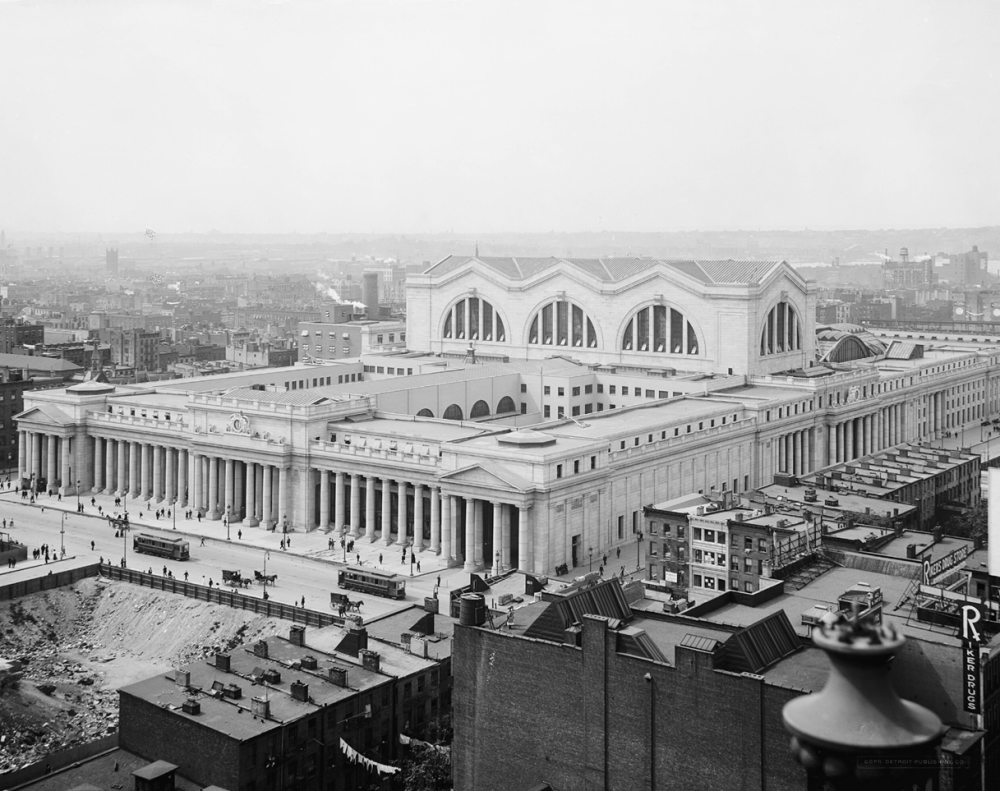
According to research from the US Federal Reserve, while railroad capex continued to rise until at least 1910, the railroad index would not recover its 1906 highs until 1926 (note that this does not include dividends). As the railroads continued to draw on the financial markets, they remained vulnerable to shocks such as the panic of 1907. Similarly today, increased data centre spending (now 14% of investment grade bond issuance) links more closely the financial markets and the tech sector. The Railroad shares had their own Index (“Dow Jones Railroad Average”), eventually named the Dow Jones Transportation Average in 1970. Research by FINEON has shown that, from 1896, the Dow Jones Transportation average lagged the Dow Jones (which adjusted the shares to reflect the changing US economy) by about 2% annually between from 1896 and 2020.
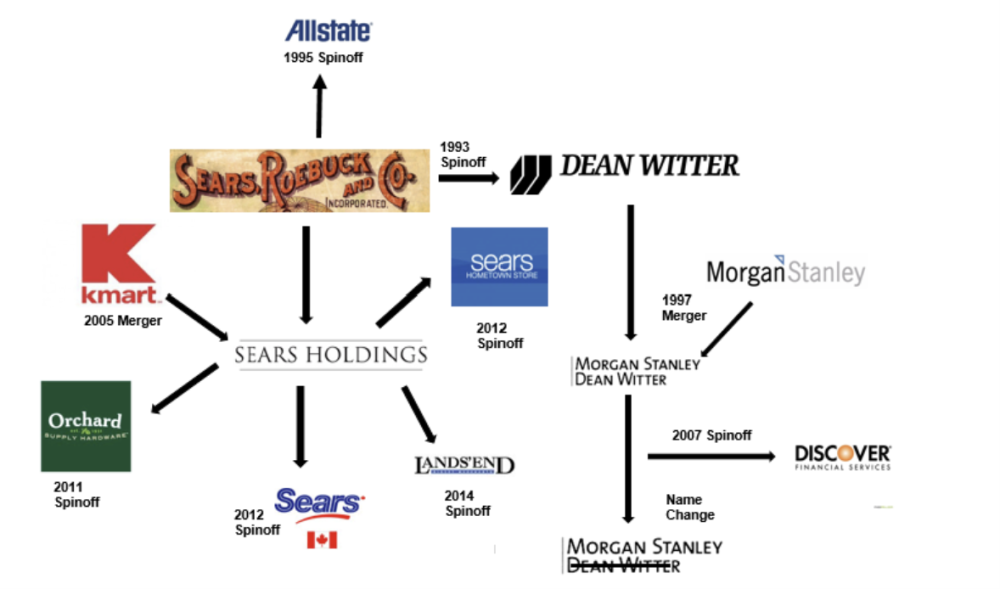
1906 was also the year of Sears’s initial public offering, issuing shares at $50 a share. Between August 1906 and December 1972, $1 invested in Sears stock grew to $928, an annual return of 11% and with reinvested dividends, shareholders would have turned $1 into $9,915, an annual return of 15% over a period of 66 years. Sears is a great example of where capex booms suddenly make new business models much more profitable. Richard Warren Sears worked as a railroad station agent in Minnesota. While he was serving as a station agent, he witnessed a jeweller refuse delivery on a shipment of watches. Sears purchased them and then sold them at a low price to the station agent, making a profit. He subsequently started a mail-order watch business in Minneapolis in 1886 with Alvah Curtis Roebuck, a watch repairman and then relocating to Chicago. By 1894, the partnership had formed a mail order “Sears” catalogue with 322 pages, with the expansion of railroads giving the company a new, low cost means of nationwide reach, efficient distribution and effective delivery. In 1981, Sears was restructured into Allstate Insurance (today’s market Cap: $54billion) and Dean Witter/Morgan Stanley (today’s market Cap: $290billion), while Sears’s retail business was taken over by Kmart in 2005.
We will be very much on the lookout for newly listed companies with business models that are able to benefit from the opportunities provided by the enormous infrastructure investment linked to AI.